See cyclones comingdays sooner.
A foundation model for the atmosphere. Forecasts that once needed a supercomputer, delivered in seconds — and free to the countries that need them most.
Trusted by forecasters, responders and industry worldwide




Impact measured in hours
Free early warnings for the public. A commercial API for industry. One model behind both.
Half the world can't see the storm coming
Traditional forecasting needs a national supercomputer, so forecast quality tracks GDP — the countries most exposed to severe weather are the least able to see it coming.
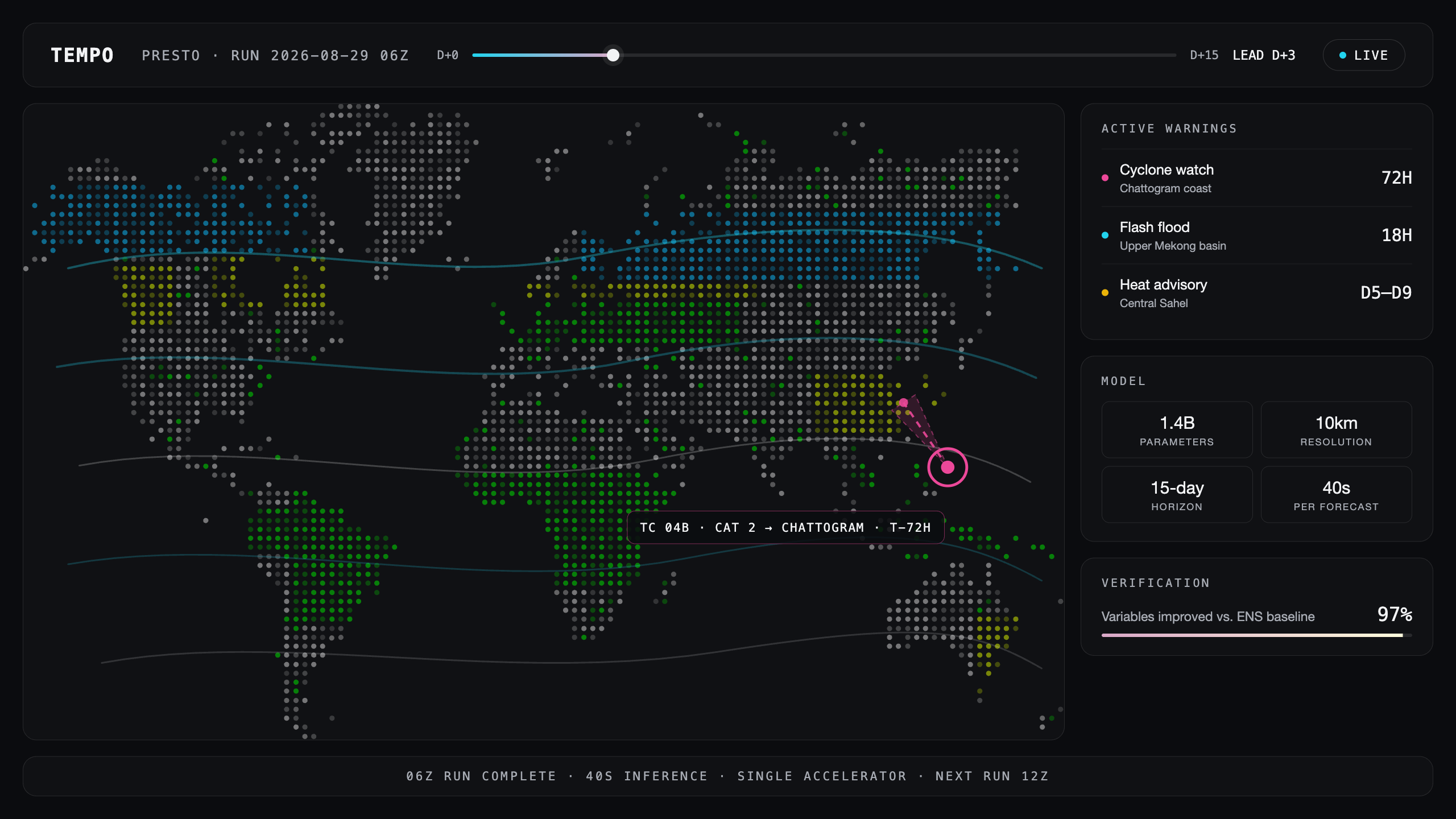
Presto collapses that cost: a world-class 15-day forecast now runs on one accelerator in 40 seconds. So TEMPO gives its severe-weather warnings to national weather and civil-protection agencies for free, paid for by the companies that run Presto commercially.
Meet Presto
Adagio proved the architecture. Allegro matched the physics ensembles. Presto beats them — a 1.4B-parameter model trained on 47 years of global atmospheric reanalysis, producing a full 15-day global forecast in 40 seconds on a single accelerator.
Deployed where the weather hits hardest
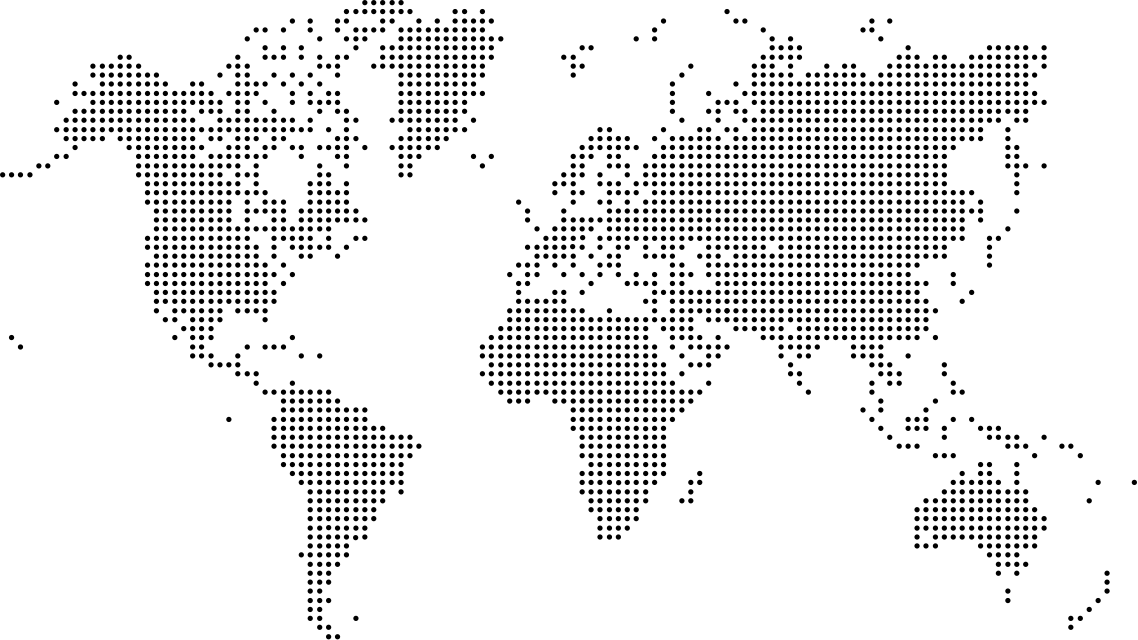
Free national-scale coverage across the world's most exposed basins and coastlines.
Selected programs
- Dhaka · Bay of Bengal cyclones
- Kingston · Caribbean hurricanes
- Niamey · Sahel rains
- Phnom Penh · Mekong floods
- Suva · Pacific cyclones
Every hour of warning matters
Presto reads the atmosphere the way language models read text — the whole planet, 15 days ahead, in a single pass. Warnings reach agencies while there's still time to act on them.




Questions, answered
Everything you need to know about TEMPO, Presto, and the free early-warning program.
Presto is trained on 47 years of global atmospheric reanalysis. Instead of simulating the physics equation by equation, it learns the dynamics from data — so a full 15-day global forecast takes one forward pass, about 40 seconds on a single accelerator, instead of hours on a supercomputer.
Presto outperforms the leading physics ensemble on 97% of atmospheric variables and cuts 5-day cyclone track error by 18%. Every forecast is continuously verified against observations, and we publish the scorecards.
National meteorological and civil-protection agencies in low- and middle-income countries. No seat limits, no data lock-in, no expiry — severe-weather early warnings are the point of the lab, not a trial tier.
Yes. Forecasts are delivered through a simple API as gridded output in standard formats (GRIB2, NetCDF), with webhook alerts that plug into existing warning systems. Most agencies are receiving live forecasts within a week.
Usage-based tiers for energy, logistics, insurance, and agriculture — priced per forecast volume. Commercial revenue is what funds the free public-warning program, so every enterprise customer extends coverage somewhere else.
Partner with us as a national agency, share station observations to improve verification, or join the lab — we hire researchers and engineers remotely. Every additional data source makes the next model generation better.
Give every country a 15-day head start
Severe weather is getting worse. Warning time is the cheapest protection there is.